REVIEW · BERLIN
Berlin Protest History Tour: Rebels, Resistance, and Revolution
Book on Viator →Operated by Beyond and Beneath Tours · Bookable on Viator
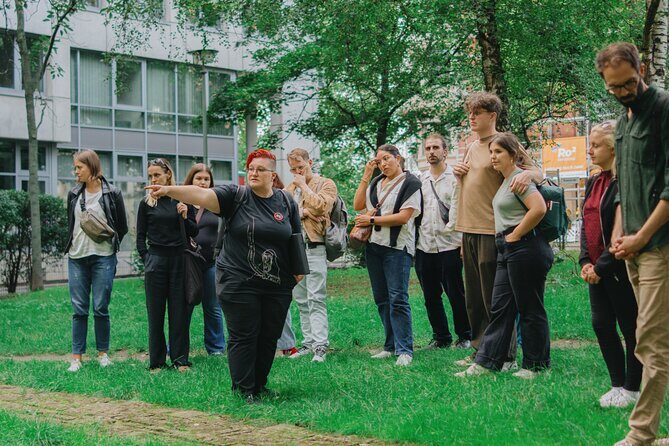
Berlin’s history turns into a street story. This tour follows protests and revolutions across central Berlin, using monuments and facade details to explain how people resisted power in very different eras. It’s not a museum crawl. It’s a walk where you learn to read what’s right in front of you.
I really like how the route mixes big ideas with human moments, especially the civil disobedience at Rosenstraße and the youth-led dissent around 1989. I also like that Beyond and Beneath’s guides (including Martina and Simone, per the style they’re known for) focus on small, meaningful details you’d miss on your own. The main drawback is timing: it’s a tight, stop-by-stop format that depends on good weather, so you won’t linger long at any one spot.
In This Review
- Key things that make this tour worth your time
- A protest-walk you can read like a map
- Starting at Rotes Rathaus and reading the city’s early revolts
- Nikolaiviertel and the “socialist stage set” effect
- Gasthaus Mutter Hoppe and the timeline that leaves out the Wall
- Marx-Engels-Forum: arguing about symbols in public space
- The Humboldt Forum and the palace that saw protests
- Rosenstraße in 1943: civil disobedience you can stand with
- St. Mary’s Church and Martin Luther King’s 1964 sermon
- The TV Tower moment: communist power you can photograph
- Brunnen der Völkerfreundschaft: the “T-shirt protest” and the fall of the Wall
- Weltzeituhr at Alexanderplatz: a meeting spot that tells you time mattered
- How long, how much, and whether the value is real
- Practical tips so you enjoy every stop
- Who should book this protest-and-revolution Berlin walk?
- Should you book Rebels, Resistance, and Revolution?
- FAQ
- How long is the Berlin Protest History Tour?
- What language is the tour offered in?
- How much does it cost?
- Where does the tour start and end?
- Is admission included for the stops?
- How many people are in a group?
- Do I get a ticket for the tour?
- Is the tour dependent on weather?
- Are service animals allowed?
Key things that make this tour worth your time
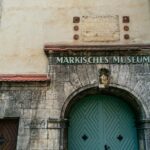
- Terracotta timeline storytelling at Rotes Rathaus and Gasthaus Mutter Hoppe
- East Germany signals and omissions, including the timeline that oddly leaves out the Berlin Wall
- Rosenstraße 1943: a rare German-led protest tied to the Final Solution
- 1989 “T-shirt protest” moments tied to the Peaceful Revolution
- You get 1848 democracy context through the rebuilt Berlin Palace at the Humboldt Forum
- Easy sightseeing finish near Alexanderplatz with the Weltzeituhr and views of the TV Tower
A protest-walk you can read like a map
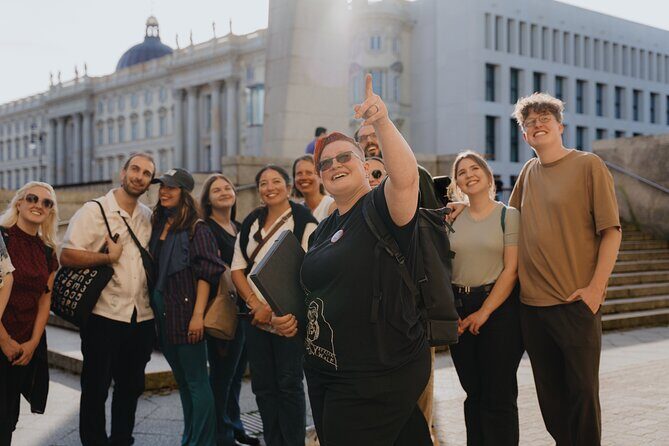
This tour works because it trains your eyes. Berlin can look like a collage of eras, but the guide helps you connect the dots: who had power, who challenged it, and how the city’s landmarks remember (or conveniently forget) those conflicts.
You’ll also get the rhythm right away. It’s around two hours, with short stops that add up. Even if you’re not a “history all day” person, the pace keeps you moving while still giving you enough time to make sense of each site.
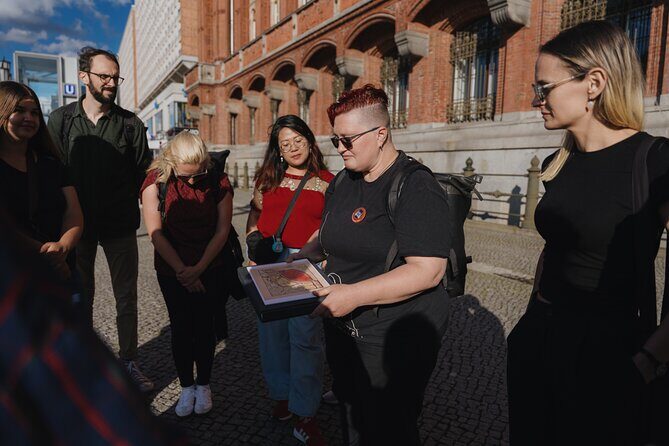
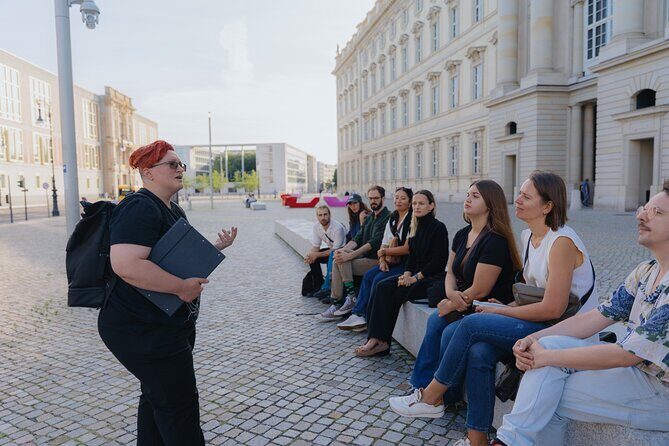
Finally, the group stays small (max 15). That matters on a topic like this, because the best moments are usually the questions: why a monument exists, what a missing detail means, and how symbols shaped public life.
You can also read our reviews of more historical tours in Berlin


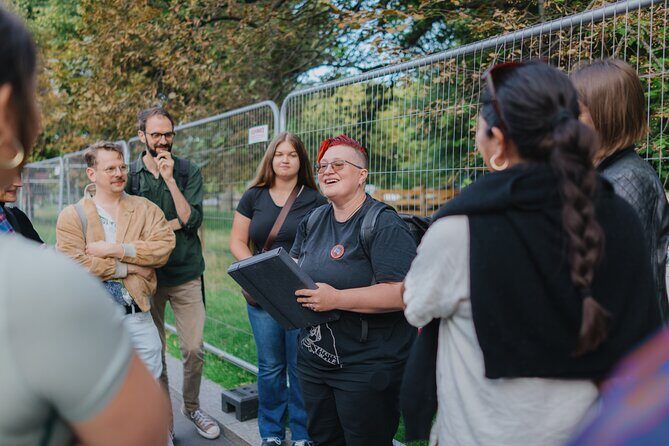
Starting at Rotes Rathaus and reading the city’s early revolts
You begin at the sculpture Aufbauhelferin by Fritz Cremer, right by the Rotes Rathaus on Jüdenstraße. It’s a practical start—easy to find, central, and a good “baseline” location for everything that follows.
The first real lesson comes from the terracotta timeline wrapped around the Red Town Hall. You’re not just looking at decoration. You’re spotting how Berlin’s story is told in stone and clay—origins of the city and the cause behind one of the early major uprisings. The guide’s job here is to help you see the timeline as an argument, not just a label: what the city chose to mark, and how it frames the past.
Even better, this stop is short (about 15 minutes) and the admission is listed as free. That means you get a strong “set-up” without losing half your tour to ticket lines or museum routines.
Nikolaiviertel and the “socialist stage set” effect
Next you head toward Nikolaiviertel, where you’ll spot an example of what you could call socialist kitsch—buildings and atmosphere designed for a big milestone (the 750th anniversary of Berlin). You’ll also hear about what’s left behind from the Palace of the Republic era: the seat of East German parliament, and a major entertainment hub for the socialist side of Berlin.
This is where the tour starts teaching a subtle skill: how to separate what’s authentic from what’s deliberately rebuilt or repackaged. You don’t need to be politically fluent to follow it. You just need to listen for the contrast between the original purpose of a site and the image later generations were given.
It’s also brief (about 10 minutes) so you keep momentum. If you like quick, meaningful photo stops, this section hits the right balance.
Gasthaus Mutter Hoppe and the timeline that leaves out the Wall
One of the more intriguing moments is at Gasthaus Mutter Hoppe. Here you’ll find an East German answer to the Red Town Hall’s terracotta timeline. And the key detail: it shows important moments in the socialist country’s history with one glaring absence—Berlin Wall coverage is suspiciously missing.
That’s a powerful teaching point for you as a visitor. A timeline doesn’t only record events; it reveals priorities. Omissions are data too. This stop is only around five minutes, but it’s the kind of five minutes that sticks because it makes you ask better questions than you came with.
It’s also admission-free on the tour, so there’s no friction. You get the idea, you take a look, and you move on.
Marx-Engels-Forum: arguing about symbols in public space
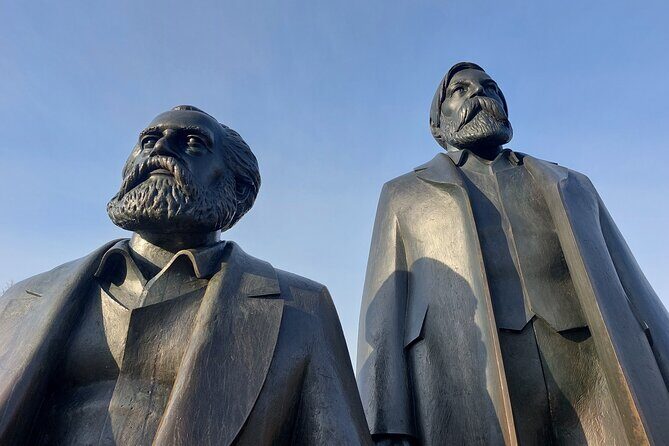
At the Marx-Engels-Forum, you meet the ideas behind The Communist Manifesto through Karl Marx and Friedrich Engels. There’s a statue, and the guide discusses how it’s been debated over the years.
This stop matters even if you don’t care about political theory, because it teaches you how public art works. A statue isn’t neutral. It’s chosen, placed, and maintained. When the meaning becomes controversial, the statue becomes part of the ongoing debate.
It’s also listed as about 15 minutes. You get enough time to see the monument and understand why people argue about it, without turning this into a lecture.

The Humboldt Forum and the palace that saw protests
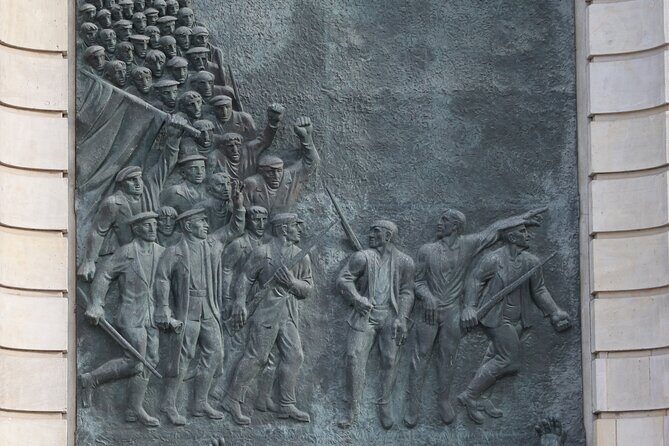
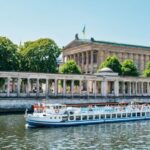
The Humboldt Forum stop is a big “why that building matters” moment. You’ll see the reconstructed Berlin Palace and connect it to protests and revolutions the original palace witnessed—especially the March Revolution of 1848, often described as the spark for democracy in Germany.
What I like here is that the guide ties politics to architecture. You’re standing in a place that has repeatedly changed meaning across regimes. The point isn’t to memorize dates. It’s to understand how power leaves physical traces—and how those traces can be reused, rebuilt, or reinterpreted.
This stop runs about 20 minutes, making it one of the longer sections. If you enjoy explanation with time to absorb what you’re looking at, you’ll appreciate this one.
Rosenstraße in 1943: civil disobedience you can stand with
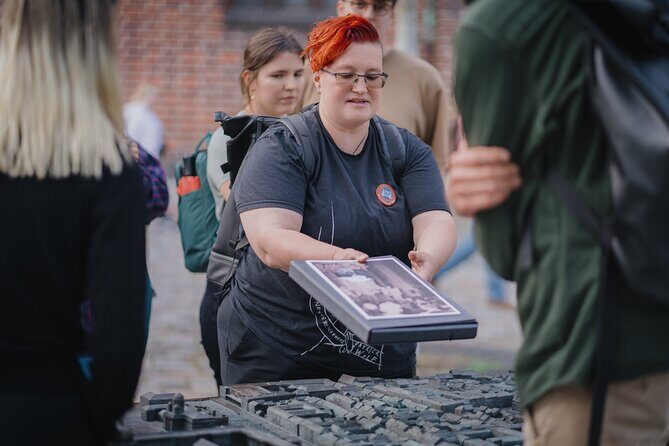
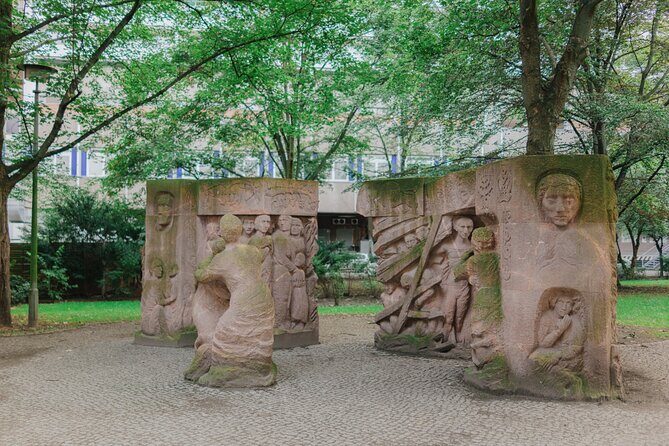
Rosenstraße is the emotional center of the walk. You’ll see the Rosenstrasse monument for the women who staged a courageous act of civil disobedience in the cold winter of 1943—described as the only protest by Germans against the Final Solution.
Then the tour expands outward to Jewish life under Nazi rule and gives you a physical anchor: you can also see the foundations of Berlin’s oldest synagogue.
This is heavy subject matter, but the format keeps it grounded. You’re not rushing past it as a checkbox. You stop, you hear the framing, and you leave with a clearer idea of why this site is so specific—and so rare in the broader story.
It’s about 15 minutes on the schedule, and that’s enough time to make it real without dragging the topic past what people can comfortably process on foot.
St. Mary’s Church and Martin Luther King’s 1964 sermon
At St. Mary’s Church, you’ll get another reminder that protest doesn’t only belong to one era or one ideology. Martin Luther King delivered a sermon here in 1964 to a huge crowd.
This is a quick stop (around 10 minutes), but it shifts your perspective. The tour connects civil rights activism to Berlin’s physical spaces in a way that feels practical, not forced. You start to notice how religious buildings often become stages for major public moments.
If you’re trying to understand Berlin as a place where different moral movements intersect, this stop helps you widen the lens.
The TV Tower moment: communist power you can photograph
At one point you’ll catch sight of Berlin’s Television Tower, a landmark and a symbol of communist power. Even if you don’t stop for a long time, you’ll understand why it’s on the tour: it’s a reminder that regimes also build their image into the skyline.
If you’re the type who likes a final photo anchor, this works. The TV Tower is instantly recognizable, so it helps you orient yourself as the walk continues toward the final East Berlin signals.
Brunnen der Völkerfreundschaft: the “T-shirt protest” and the fall of the Wall
Near the end, you get to the Peaceful Revolution of 1989 through Brunnen der Volkerfreundschaft. This is where the tour shifts from earlier resistance to the closer, lived memory of the East German opposition.
You’ll trace the events that led to the Fall of the Wall, and you’ll hear about young East German oppositionists who staged a “T-shirt protest” by the fountain in autumn 1989.
I like this section because it brings resistance into the language of everyday objects—clothing, a visible message, a simple but bold act in a public place. It’s a good bridge between politics and human behavior, and it helps you see the revolution as something started by real people in real streets.
It’s about 15 minutes here, and you leave with a clearer picture of how quickly momentum can shift when people decide not to stay quiet.
Weltzeituhr at Alexanderplatz: a meeting spot that tells you time mattered
Your finish point is right by the World Time Clock (Weltzeituhr) at Alexanderplatz. You’ll stand at the most popular meeting spot in East Berlin, and the rotating clock shows time in 148 cities around the world.
This feels almost symbolic after everything you learned: Berlin didn’t just struggle over walls and parliaments. It also cared about connection, visibility, and how the rest of the world sees you.
The stop is around 15 minutes, and it ends at a place that’s easy to continue sightseeing. You’re also close to public transport, which makes the walk feel less like a commitment and more like a smart, efficient afternoon.
How long, how much, and whether the value is real
The price is $30.04 per person for about two hours, and it includes an expert guide. Given the number of distinct stops and the fact that the listed admission tickets are free at the sites you visit, the value mostly comes from interpretation—not entry fees.
I’d treat it as a “guided reading of Berlin” deal. If you’re the kind of visitor who wants to understand what you’re looking at, this price makes sense. If you only want general facts with lots of independent time, you could get a similar photo list alone. But you’d miss the connections the guide is clearly making through timelines, monuments, and context.
In terms of walking, the route is described as a small walk of about 2 km. That’s not a lot, but the pace still matters because many stops are short. You’ll do best if you’re comfortable moving between sites and listening during brief viewing windows.
Practical tips so you enjoy every stop
- Bring a light jacket or an extra layer. The tour is weather-dependent, and you’ll be outside for most of the time.
- Pace your photos. Some stops are only five to ten minutes, so don’t spend the entire viewing window shooting only your angles.
- Listen for what’s missing. The timeline omission at Gasthaus Mutter Hoppe is a clue you’ll start noticing elsewhere if you pay attention.
- If Rosenstraße affects you emotionally, it’s okay to take a breath and look slowly. That stop is built for meaning, not speed.
Who should book this protest-and-revolution Berlin walk?
Book it if you want Berlin to make sense as a chain of resistance, not just as architecture. You’ll especially like it if you enjoy monuments that have arguments attached to them: statues, timelines, memorials, and rebuilt spaces that carry political meaning.
It’s also a strong match for people who like short guided segments. The format gives you enough explanation to connect sites, but it doesn’t trap you in one museum room.
If you’re traveling with limited mobility or you get tired quickly on flat walking tours, consider that this is still a walking route with several quick stops. It’s not described as strenuous, but it’s still outdoors for the better part of the experience.
Should you book Rebels, Resistance, and Revolution?
I think it’s an easy yes for history-minded visitors who like authentic city reading. The tour’s strongest asset is how it uses Berlin’s physical details—terracotta timelines, missing wall context, memorials like Rosenstraße, and public art—to turn a walk into a clear narrative.
I’d only skip it if you’re looking for long museum time or a flexible, slow itinerary. This experience is tight by design. When the weather cooperates, it’s a smart way to understand Berlin in a couple of hours.
FAQ
How long is the Berlin Protest History Tour?
It’s about 2 hours long.
What language is the tour offered in?
The tour is offered in English.
How much does it cost?
The price is $30.04 per person.
Where does the tour start and end?
It starts at the Sculpture Aufbauhelferin – Fritz Cremer at Rotes Rathaus (Jüdenstraße, 10178 Berlin) and ends at the World Time Clock (Weltzeituhr) by Alexanderplatz (Alexanderpl. 1, 10178 Berlin).
Is admission included for the stops?
Yes. The stops listed on the route show admission ticket as free.
How many people are in a group?
The tour has a maximum of 15 travelers.
Do I get a ticket for the tour?
You receive a mobile ticket.
Is the tour dependent on weather?
Yes. It requires good weather, and if it’s canceled for poor weather you’ll be offered another date or a full refund.
Are service animals allowed?
Yes, service animals are allowed.