REVIEW · BERLIN
In Search of Jewish Berlin Walking Tour
Book on Viator →Operated by Insight Cities · Bookable on Viator
Jewish Berlin lands with force. This 3-hour walking tour strings together the big turning points of German Jewish life with a Jewish history scholar leading you through the Scheunenviertel and beyond, including the New Synagogue and the Holocaust Memorial. It’s the kind of route that gives you names, dates, and context fast, without turning the day into a lecture.
I especially like two things: first, the small group size (max 10) keeps the conversation human, not rushed, and you can ask what you actually want to ask. Second, the guides bring real academic and personal grounding. I’ve seen how different guides (like Ioana N., Heather, and Isabel Daniel) handle sensitive material with care, and still keep the details clear enough that you leave with a map in your head, not just facts.
One possible drawback: the stops are tightly timed, so you won’t have hours inside museums or galleries. With memorials and emotionally heavy sites, that can feel right for some people and too short for others—so come ready to take notes, and plan follow-up time if a place catches your attention.
In This Review
- Key highlights worth your attention
- Where Jewish Berlin’s story really begins
- New Synagogue at Centrum Judaicum: architecture with a message
- Auguststraße 11–13: a Girls’ School you can learn from
- Die Hackeschen Hoefe: community stories around Hackescher Markt
- Block der Frauen: remembering resistance, not only deportation
- The Holocaust Memorial: walking 2,711 slabs slowly
- Timing, walking, and how to plan your day
- Price and value: what $156.53 buys you
- Who this tour suits best
- Should you book this Jewish Berlin walking tour?
- FAQ
- How long is the tour?
- What language is the tour offered in?
- What’s the group size?
- What’s included in the price?
- Is food included?
- Where does the tour start?
- Is admission free at the main stops?
Key highlights worth your attention
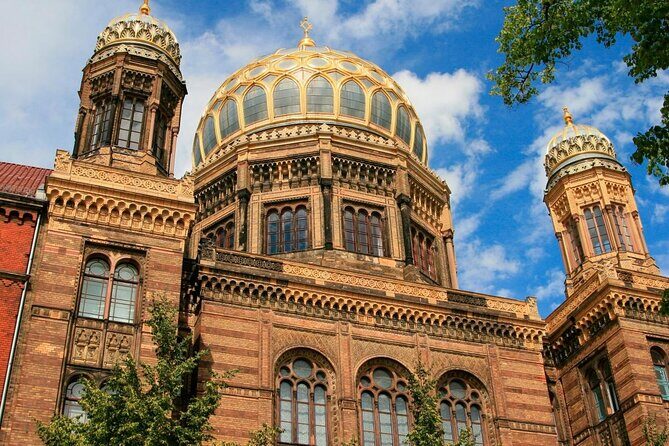
- New Synagogue at Centrum Judaicum: 19th-century architecture tied to Jewish life and later renewal
- Auguststraße 11–13: a historic Girls’ School building from 1927–1928, in the New Objectivity style
- Hackesche Höfe: courthouse courtyards and streets around Hackescher Markt that shaped community life
- Block der Frauen: a memorial focused on protests by non-Jewish wives and relatives during Nazi arrests
- Holocaust Memorial’s concrete labyrinth: a designed route through 2,711 slabs meant to slow you down
- Max 10 people, English: a guided walk that stays discussion-friendly
Where Jewish Berlin’s story really begins
This tour is built for one goal: help you understand Jewish Berlin as more than a single tragic chapter. You start in the Scheunenviertel area, the so-called Barn Quarter, where Jewish institutions and everyday life clustered, especially in the late 19th and early 20th centuries. Then the route widens to the sites that show how Berlin changed—sometimes through laws and institutions, sometimes through violence, and sometimes through remembrance.
The best part is that you’re not stuck with vague “then it got worse” storytelling. The guide gives you a thread you can follow: what Jewish communities built, how they lived side by side with wider society, and how Nazi policy shattered that world. If you want the kind of overview that still feels specific, this is a good format.
You’ll also like the pace. It moves through the city like a conversation, not like a race. Because the group stays small, you’re more likely to get a direct answer when you ask about a monument’s meaning or the role of a particular building.
You can also read our reviews of more walking tours in Berlin



New Synagogue at Centrum Judaicum: architecture with a message
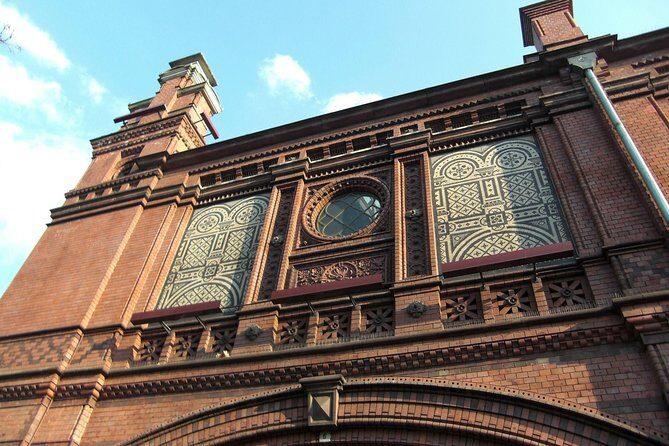
Stop one brings you to the Stiftung Neue Synagoge Berlin – Centrum Judaicum. The New Synagogue’s big, formal architecture isn’t just pretty. It marked a moment when Jewish life in Germany pushed for visibility and recognition in the 19th century. In other words, the building was both a house of worship and a public statement.
What makes this stop especially moving is the contrast between then and now. Today it’s connected to a Jewish community that’s reviving in Berlin. So even if you already know the broad story of assimilation and persecution, you get to see a living through-line: the place is still used, still meaningful, and still part of Berlin’s present.
Practical note: this stop is listed as around 20 minutes and has free admission. That’s enough time to orient yourself, look closely at what you’re seeing, and get your guide’s framing. If you’re the type who likes to linger, plan to return later on your own.
Auguststraße 11–13: a Girls’ School you can learn from
Next you walk to Auguststraße, once a stretch with many Jewish institutions. A key stop here is the former Jewish Girls’ School building at Auguststraße 11–13, built by architect Alexander Beer. The building is characterized by the New Objectivity style, which tends to feel practical, clean, and modern for its era.
The reason I like this stop is that it turns “Jewish history” into “Jewish everyday life.” Schools, education, and community infrastructure matter because they show normal life existed alongside political tension and social change. It also gives you a way to picture the daily routines people had—studying, learning, planning futures.
You’ll also get a helpful bonus here: the building is used today for an exhibit hall and a coffee shop. That means you can turn a quick historic stop into a longer break if you want. Admission is free for this part, and the time on the ground is about 20 minutes, so you’ll likely be guided to the key things to notice.
Die Hackeschen Hoefe: community stories around Hackescher Markt
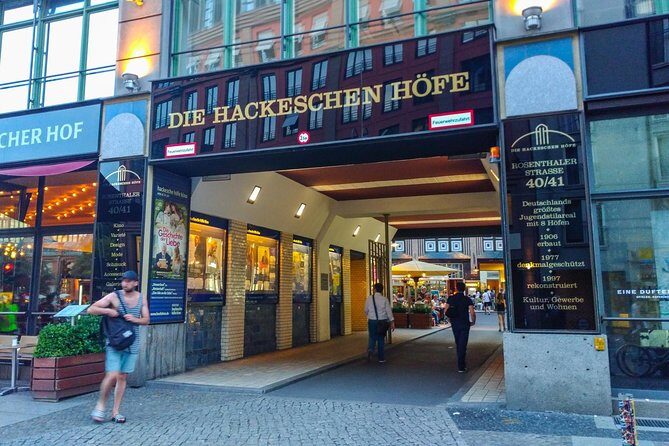
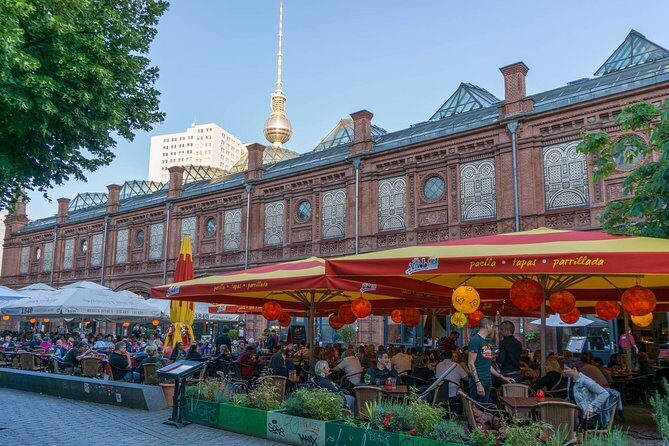
Then comes Die Hackeschen Hoefe, centered around the area near Hackescher Markt. This is where the tour’s “community geography” becomes clearer. Instead of treating Jewish Berlin as one isolated monument, you see how life developed around streets, courtyards, and neighborhood hubs.
The courtyards are also a great setting for stories. The guide can connect the architecture you’re looking at to how people moved through the Scheunenviertel and Spandauer Vorstadt. You start understanding the feel of the place: where you’d likely shop, where institutions clustered, and how a community could stay connected even as Berlin rapidly modernized.
This stop is listed at about 30 minutes, with free admission. That longer block helps here because a courtyard setting takes a few minutes just to scan visually. If you like photos, this is one of the better stretches for that—just keep in mind you’ll still want to listen, not just shoot.
Block der Frauen: remembering resistance, not only deportation
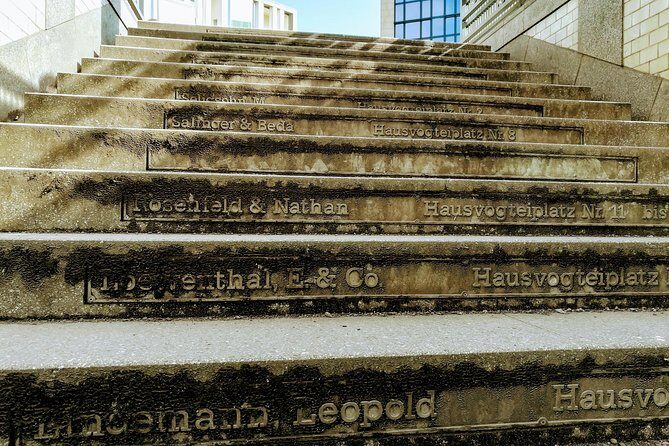
Stop four is Block der Frauen, a memorial that focuses on sustained protest demonstrations by non-Jewish wives and relatives of Jewish men who were arrested by the Nazis and targeted for deportation.
This is a powerful pivot in the story. It reminds you that moral choices weren’t automatic or automatic opposites. Some people protested even at huge personal risk. And it shifts your attention beyond the usual victim-only framing, toward the human impulse to resist injustice in real time.
The stop is about 20 minutes and has free admission, which is a tough amount of time for a site like this. But that timing also means you won’t be rushed through numbness—you’ll be encouraged to feel the weight, absorb the message, then move on with your guide’s context so it lands as meaning, not just emotion.
If you tend to get overwhelmed at memorials, consider bringing a little buffer after the tour. You’ll likely want a calm walk back to process what you just learned.





The Holocaust Memorial: walking 2,711 slabs slowly
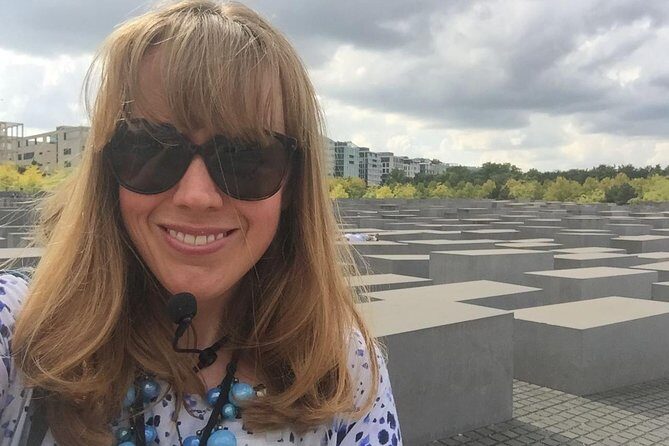
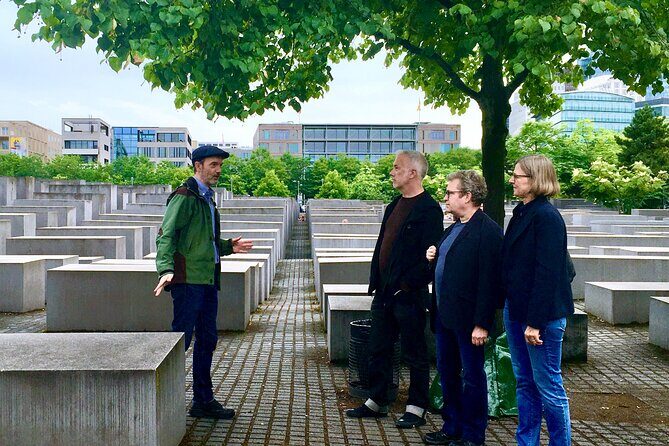
The final major stop is The Holocaust Memorial – Memorial to the Murdered Jews of Europe, designed by architect Peter Eisenman. Here you’ll walk through a sobering labyrinth made of 2,711 concrete slabs meant to represent Germany’s acknowledgment of the Holocaust.
This isn’t an “explainer” stop in the usual sense. The architecture does the teaching. The slabs create confusion of space—standing still can feel different than moving through it, and that design choice is part of why it stays with you.
The tour lists about 20 minutes here, free admission. That’s enough for the designed experience (walking, pausing, letting the scale hit you), but it’s not enough if you want to read everything at full length or sit with a specific panel for a long time. If you’re someone who needs time to grieve in place, plan a return visit.
When the group moves on, you may feel that weird aftertaste you get after seeing something too intense. That’s normal. The tour’s value is that it gives you context first, so the experience has grounding, not mystery.
Timing, walking, and how to plan your day
You’re looking at roughly 3 hours on foot. For many people, that’s a comfortable length for a city walk that includes multiple major sites without feeling like your legs are the only thing getting a workout.
Still, it’s smart to dress like you’re walking 3 hours in Berlin, including cold mornings or afternoon wind. Some stops are architectural and outdoor-facing, and the memorial experience works best when you can slow your body down and not feel rushed by discomfort.
Also, remember that food and drinks are not included. That matters because you’ll be processing emotionally heavy content. Plan for a café stop before or after the tour so you’re not making decisions on an empty stomach while your brain is busy with history.
If you want to avoid feeling squeezed, give yourself a little slack in your schedule. This tour covers a lot of ground in a short time. It’s not a “rest and snack” format.
Price and value: what $156.53 buys you
At $156.53 per person, this isn’t the cheapest way to learn about Jewish Berlin. But the price makes more sense when you look at what’s included:
- A 3-hour guided walk with a Jewish Studies scholar
- A small group (max 10), which is a big deal for Q&A time
- Access to several stops marked as free admission for this portion of the experience
- English language hosting
- A mobile ticket, which can make the check-in experience simpler
Group discounts are also listed, which usually helps if you’re traveling with someone. And because the tour is often booked about 66 days in advance, it’s worth planning early rather than hoping for last-minute flexibility.
So the value isn’t in buying tickets. The value is in the interpretation: a good guide can turn what you’d miss on your own—symbols, context, and the link between different neighborhood sites—into a coherent story.
Who this tour suits best
This is a strong choice if you want:
- A guided overview of Jewish Berlin that covers both community life and the later horror of Nazi persecution
- A route built around major physical sites, including the New Synagogue and the Holocaust Memorial
- A format where a guide can answer your questions instead of pushing you through a script
You might prefer something else if you’re looking for a deep museum day with long indoor time at each venue. This walk is designed to be focused and paced. It will give you a foundation. Then you can choose what deserves extra hours.
Based on guide experiences people shared—especially praise for empathy and clear explanations—this also fits travelers who care about handling sensitive subjects with care. If that’s you, you’ll likely appreciate the thoughtful tone set by the scholars and storytellers leading the group.
Should you book this Jewish Berlin walking tour?
If you want a structured, small-group introduction to Jewish Berlin that connects architecture, institutions, and memorial meaning, I think you should book. The combination of a Jewish history scholar, a 10-person cap, and a route that hits both everyday life sites and major Holocaust remembrance makes it a practical way to get your bearings fast.
If you hate walking, or you need long quiet time inside buildings, you may find the timed stops limiting. In that case, consider using this tour as your orientation, then return on your own to the places that pull you in.
Either way, go in with realistic expectations: this is a guided framework for understanding. The best follow-up is your own slower visit to the sites that stayed with you after the walk.
FAQ
How long is the tour?
It’s listed at about 3 hours.
What language is the tour offered in?
The tour is offered in English.
What’s the group size?
The tour has a maximum of 10 travelers.
What’s included in the price?
The tour includes a 3-hour guided experience in the company of a Jewish Studies scholar.
Is food included?
No. Food and drinks are not included.
Where does the tour start?
It starts at Rosenthaler Str. 40/41, 10178 Berlin, Germany.
Is admission free at the main stops?
The listed stops include admission tickets marked as free.